

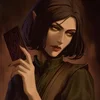
Chapter 5
January 7, 2026 at 12:01 PM
Under polished bootheels, fallen leaves crackled. Moonlight, sly as a spy, trailed him through the branches of the high trees. The forest air was denser and colder here, almost unused to sunlight. Ahead, an estate rose, ringed by a neglected little garden. Built of dark brick, it stood two storeys high. A protective tangle of vine lay across the walls, hiding narrow, tall windows from prying eyes.
On the small stone stoop stood a fair-haired man of middle years, his hair a pale halo against the gloom. Seeing his guest, he stepped down a stair and spread a courteous smile.
“Thomas,” he said, thrusting a hand out from beneath a fur-lined cloak.
“Malric,” Kane replied, gripping the man’s hand without looking away.
“Don’t judge too harshly. It’s a summer house. It's not the season,” Sinclair said, glancing at the overgrown walls before sweeping the door open with a flourish and ushering his guest in.
Logs crackled in the hearth, lighting a comfortably appointed sitting-room. Malric’s words felt believable: a thin dust, like a veil of snow, covered the furniture. The air smelled of age and stuffiness. Thomas shrugged off his gloves as he walked down the corridor. The host fussed about behind him, waving his wand by the door.
“Something to warm you?” Malric offered. “I’m frozen stiff from that blasted wood. Whether it’s fallen or not…” He shoved his wand into the pocket of his cloak. The door behind them shimmered with a bluish ripple of energy.
“No, thanks. Are they here?” Thomas arched an eyebrow and scanned the short corridor and the rooms on the ground floor. The space did not look as if it could hold anything very large. Sinclair smiled slyly and pointed toward the back corridor leading out to the yard.
“I’ve stashed our friends out back,” he said, looping around Thomas in no hurry. Kane followed without comment, casting sideways glances at the family portraits that hung along the corridor: pompous, flattering likenesses of the family in various groupings.
“Try not to make a racket,” Malric said, easing a door open and stepping out first.
From the house you could see the wood continuing behind the garden. A ruined farmhouse showed dimly on the far edge of the clearing.
“Occupied?” Thomas squinted at the distant silhouette. Malric waved his hand.
“Abandoned. For about fifteen years now,” the man nodded and turned his attention back to his guest. “A pity. My sister used to play with their little girl. They would run about here. Good old times.”
“I didn’t know your sister had friends,” Kane said, eyeing his companion. Malric clasped his hands together and in the brief silence shot Thomas a scorching look.
“You know, I would say the same about you.”
Without wasting time on pleasantries, Malric beckoned Thomas to follow. Their bodies slid through the frosty, piercing air. For a moment the world seemed to blur and the clearing and yard revealed their deepest secret: several large, massive cages loomed, dark blotches streaked with blood-red stains. Burgundy scales pressed through the bars and from the gloom several pairs of large, yellow eyes glared back. Thomas paused, taking in the imprisoned beasts. Muzzles were gagged with muzzles wide enough to hold both creatures’ heads. He could not look away; with almost childish eagerness he stepped closer.
“Impressive,” Malric murmured, joining him. “We left the smaller ones at the tree-line. Those creatures are real brutes.”
“Notice anything odd?” Thomas slid a hand between the bars. As soon as his fingers brushed the scales a warmth spread up his arm. A dragon shifted, lowering its head and letting out a low, disgruntled growl. Malric kept his wand ready. Kane did not withdraw his hand.
“I don’t think so. Nothing I would call strange. Just...dragons. You think someone hid something inside them?”
Kane was not one for small talk. His eyes studied the gargantuan form. The beast lifted its head, losing interest in its keepers; a hollow roar rolled up from its throat, resonating in Thomas’s chest.
“I’m not certain,” he said at last, stepping back and pulling on his glove. Turning to Sinclair, Thomas shook his sleeves into place under his coat. “But I have no time for uncertainty. Watch them. As for the young ones,” he nodded toward the smaller cages at the tree-line, “do what you will. Feed them with potions and draughts, charm them — by the end of winter they should be in better form.”
“What are we preparing for?” Malric asked after a pause. His tone held no fear — only a businesslike curiosity.
“War, Malric. We are preparing for war.”
***
A sleepless night of roaming and thinking left Anna dazzled by the harsh first rays of dawn. Battle-ready, she returned home at five in the morning - Antonin was still not there. Sitting by the bookcase, the only small island in his house marked as “mine,” she tried in vain to assemble the picture. The book Thomas had given her served as a prop under the parchment. Flyers -> New Order -> Antonin, Xander Antonin -> Farm in the South -> Rupert Ignis -> Isidore Lockford -> Thomas Kane All the variables formed parallel sequences in the same span of time. Then why, Theo had said, had Isidore been at the barn meeting? What if one looked at the events as parts of a whole? The nib of her pen crossed out an old diagram. Turning the parchment over, Anna began again. The first event, circled, stood at the top of the new scheme:Dragons
Rupert Ignis
Kane Tony
Isidore New Order
Magistrarium Xander
So, she thought, joining the final strands: Tony and Xander. Perhaps Thomas Kane had commissioned the farm — asked me and Tony to arrange the meeting with Ignis, keep an eye on Isidore, who was frightened by something connected to the uprising. Which tied to Tony and Xander… The answer felt both very near and impossibly far. The sense of connection would not leave her. Tension in her muscles gave way to exhaustion. Leaning back against the bookcase, she stretched her legs. With a deep sigh Anna set the parchment down on the floor beside her. The familiar title on the cover called to her: The Ten Peculiarities of Divination. Her fingers lazily turned the pages. Peculiarity Three: False Interpretations. Many fledgling seers suppose that Divination is the art of seeing truth in its pure form. This is a dangerous delusion. Divination rarely speaks plainly and almost never sheds light on the whole event. A false divination arises when the seer sees the correct image but ascribes the wrong meaning. “Remember,” the looping, crimson letters urged, “the divination does not lie - the interpretation does.” The elemental pages were fit only for senior students. Anna barely read the text; she was drawn to the illustrations. Time-darkened plates depicted images and their possible meanings: a tower falling on a gathered crowd; enormous serpents with gaping, threatening maws. On the book’s back cover, a blot of ink formed a distant likeness of the Council building, except the tower count was different: the castle in the drawing had ten towers. At the bottom of the cover, in black ink, a dedication ran: To my dear friend. For the Chimera shop, a private collection of artefacts and historical texts. Chimera. Her eyes dropped to one of the names on the parchment. Could Thomas be connected to… Chimera? Three stone heads, frozen in different grimaces, greeted passersby. The middle head wore a sardonic, unnerving smile; the flanking faces showed sorrow and malice. Below, a sign read: Chimera. Anna hesitated at the door handle, glancing down the empty lanes of the Middle City. Hugging the book to her chest as if it might fend off the unknown within, she pushed the door open. Chimera proved to be a small shop. It was cramped but not stuffy. The space seemed to compress around her, forcing slow, careful steps. A narrow aisle led deeper into the store. Dark-green walls were nearly hidden behind crowded shelves. Books stood pressed together in uneven rows, differing in thickness, binding colour and wear. Some were fastened with metal clasps, others bound in faded ribbons. Between the volumes lay objects not immediately recognisable: a shard of obsidian, a copper seal rubbed thin by use, a glass sphere cracked with a forever-cloudy sheen trapped within. The smell was dense and layered. Old paper mingled with wax and dried herbs. The air and the very sense of time felt still. At the far wall a desk stood. Behind it, in a high-backed chair, sat a man bent over scrolls and tomes. Despite the disorder of paper, an order showed itself: open books lay to the right, while scrolls and scraps clustered strictly to the left. “Good morning,” Anna ventured uncertainly as she reached the desk. The man did not look surprised; he kept his finger following a line of script. Anna pressed her lips together and tapped the book in her hands a little louder. Only when he finished the sentence did Thomas raise his head. “Miss Erter,” he said, voice unsurprised. Kane leaned back and folded his hands on the desk. Anna sat in the chair by the table without waiting for an invitation, staring at him. “Good morning,” he said with a polite, charming smile that tried, and failed to hide the bags beneath his eyes. Only the sunlight that pushed through the window lent him freshness. “How may I help you?” “I came to return this,” she said, laying the book gently on the table. She pressed back into the chair; her hands fell to the armrests. Thomas inclined his head and nudged the book nearer with a small, almost tender movement. “You needn’t. I fear you will find it of use yet.” “I doubt it,” she said, bluntly. “Did you do what I asked?” he cut in almost at once. Even after all these years Kane spoke with that professorial cadence: precise, dry, measured. “Maybe,” she replied, shrugging and twisting her fingers together. “Anna—” “Thomas,” she answered. The audacity of using his first name tightened her stomach. She forced a polite smile which the nerves cheapened into something sly. Her foot swung under the table, hidden from the former professor’s sight. Kane smiled. For a moment his chuckle seemed almost frighteningly genuine. He leaned forward, studying her face and buying time, giving her a chance to break under the pressure. She said and did nothing. “Well, you have not lost your character,” the stern tone returned as the smile faded. “Let us return to the matter. I do understand your… concerns. Work must be paid...in proportion to its quality.” “Now I need answers more than coin,” Anna said, leaning forward and planting her elbows on either side of the book. “Will you help me, Professor?” “For starters, leave the playground games for home, Anna,” he replied, calm and rational rather than threatening. Though her pride was clearly wounded. He leaned back in his chair as if nothing had happened. The silence that settled between them was pensive, thick. "Anyway, ask. I'll do my best to meet your needs". Anna breathed in and stared down at the book. She needed a beginning; there were so many questions choosing the important ones was hard. “Why,” she began haltingly, “is Lockford so afraid of the uprising?” Thomas raised an eyebrow in genuine surprise. “Let me put it another way. You already have what you wanted. Why Lockford? He’s merely a breeder of dragons.” “When matters concern the ruling families, nothing is mere,” he said with a theatrical sigh and swept his hand around them. “I need to find a family relic. I believe mister Lockford may possess it, or at least know where it is hidden.” He gave her the moment to take that in. Her eyes flitted over his face, his neat shirt, then dropped to the table. “Why not ask Tony to do it?” “As far as I know, Mister Bannerman is busy. You are not a stranger, you are under watch. No risks,” Thomas shrugged, palms outward. “And still...Lockford…” Her gaze returned to Thomas’s thoughtful face. Smoothly, as if by habit, he stretched the answers out and used the pauses to emphasise key points. “Lockford is an old man frightened by change. Revolutions are the business of sons, not fathers.” Anna watched him in silence. His hand reached for a shelf in the desk. On top of a stack of parchments he set down a battered book bound in flayed leather. “I am certain we can help one another,” he said without waiting for a protest. “An Archon is no mere office. Magic has changed in our time. In ancient days it was different. Children were not registered, nor cut off from the Source that is nowdays being sealed into their wands.” Kane turned the fragile pages carefully. He slid the book closer to Anna and let his hand pass over a faded illustration of nine wizards standing in a circle among sharp rocks. Around each, washed in ink, floated names: Ignis, Hibern, Solas, Ventus, Terron, Abbis, Viridian, Mentis and Larric. “Founders?” she leaned in. “Archons,” he corrected. “History smooths its corners. Having sworn silence, they enclosed the very essence of magic into nine relics. With them they quelled volcanoes, commanded minds, fates and death by magic itself. Fearing betrayal, as you put it, the founders hid the relics and passed the secret down the line.” He turned the page. The illustrations became cruder, the lines harder: ritual circles, sigils, schematic depictions of the Source. “And you are looking for...” Anna frowned as the pages flicked. “The Ruby,” Thomas said, his finger resting on the illustration. On the parchment the stone was sketched roughly, yet it drew the eye. Jagged, hewn from the very bedrock, it bore no neat facets. Its shape looked like a frozen drop, elongated and heavy, caught in the moment of descent. The shading around the ruby was darker and heavier than on other illustrations, as if the artist had strained to keep it on the page. Kane settled back into his chair. Anna’s hand went almost of its own accord to the picture; her fingertips traced the ruby’s edge. “I always thought they were myth. That they did not exist.” “Lost, perhaps. Unreal? Hardly,” he paused gently. “I will answer all your questions if you find it. The world is changing, Anna. Whether you like it or not, you are already part of those changes. All that remains is to take a favourable position.” His eyes narrowed, finding her face. He sounded, for a moment, like a tempter urging a bargain with the Devil. “And which side are you on, then?” “On mine, of course.” Silence thickened and became almost tactile - the kind that makes words unnecessary. She slowly drew her hand from the page as if afraid the ruby might leave a mark on her skin, and closed the book.
