

Chapter 6
November 14, 2023 at 1:33 AM
Wei Ying, Wei Wuxian, Yiling Laozu Wei-zhengshi wakes up, and he hates that fact with every fiber of his being.
He wakes up, and the night greets him, kissing him with street lights and sticky-warm wind.
He wakes up feeling deeply tired, the shadows whisper consolations, embrace him, stroke him, touch him — he can’t stand the touch, he wants to get rid of his skin, he craves their touch.
He doesn’t know what he wants, and he chuckles at it; he’s tired, so tired.
Wei Ying stands up, throwing back the blankets, it’s hard, his limbs shake and his knees buckle, he feels nauseous and dark before his eyes, and the shadows whisper-whisper-and-whisper for him to stop, knowing where he’s going — he ignores it all, walking along the walls higher and higher, barely managing to pull himself up.
Weakness hums along with him; in everything; from his movements to his breathing.
There are no stars, and the lights of the city reflect off the clouds so much that he can almost believe that the sky is red, that he is in the Burial Mounds; if he closes his eyes, he can visualize one of the hundreds of peaks he was thrown down from; the rooftops and cliffs of the Nightless City are high enough that even a cultivator wouldn’t survive the fall, what if we’re talking about someone who suffered a qi deviation the day before?
Wei Ying smiles slightly at this, swinging towards the edge.
Falling should be more pleasant than thousand hands.
His whole death.
Wei Ying laughs as he reaches for the wine jug; his chest aches as if his ribs are writhing outward; he wants to cry but laughs — he wants a hug, he wants hands on his body but flinches every time, waiting-waiting-waiting and wishing for pain. The kind that will send him to places he can’t access — shadows whispered apologies and consolations to him; even the darkness can empathize.
And isn’t it ironic, he thinks, when his hand flies to the wine and his mouth to his husband. It’s wild, it’s sweet, it’s scary — his life has worked out in such a way that he’s known affection, but not all of it has been by his decision (the streets have not been kind to him). And he doesn’t know exactly why he does what he does.
It’s the wine.
Or his stupidity.
Maybe it’s all of them at once?
(Somewhere between drunkenness, duty and hate).
Wen-zongzhu leads him in a kiss, more tenderly than he could have imagined; but it ends faster than the rainy season whips by; Wei Ying smiles as he deflects, still snatching the jug back. Two gulps, sliding the excess down his throat and he smiles; it hardly came out silky or sane.
Wei Ying smiles and looks at the grim face of the man he should have killed before their marriage — thought that comes to reflect on his own dagger hidden in the folds of his black robes and the thin hairpin scratching his head.
“Wen-zongzhu”, and he unties his belt, and it falls so easily; he has two layers of clothing, instead of the decent three, not to mention the fourth or fifth he should have worn, given his new status; he smiles, and doesn’t think it came out docile; “hey, Wen-zongzhu”, he breathes the man’s alien breath that still doesn’t touch him, not forgetting to ask, “should I not, as a good husband, do my duty?”
Wei Ying is not sure what he feels; there is sadness there, there is pain there, there is contempt there; maybe for his husband; more likely for himself.
Wei Ying thinks he wants to feel hands on him: alien, relentless, merciless; tearing him and devouring his flesh.
Wei Ying thinks he’s hungry for pain. More pain. To make the suffering of his body match the rotting state inside. What he remembers. Who he was.
Not the boy he stole.
The monster deserves nothing less than pain in return for everything.
Wei Ying breathes emptiness and feeds on pain — is all he has.
But his husband stops him, turning away, pulling away; in a minimum of touch: stern, warm and effective.
“Yiling Laozu”, Wen-zongzhu sits in front of him, returning him to the cushions; someone else’s knees in white are getting dirty against the floor, and he thinks how hard it must be to walk around in white all the time (he knows it, A-Yuan soiled the fabrics minute by minute), “look at me”, and Wei Ying stares, into dark red eyes where he looks for disgust, looks for mockery, looks for indifference; anything but concern; it makes him look too much like Qing-jie. “Yiling Laozu, I would give you this if you really wanted it”, there is no embarrassment or hesitation; Wei Ying almost envies such nonchalance; “but it’s not what you want. Or not what you need”, Wei Ying shakes the jug fruitlessly, as if expecting something new to appear there; the smile that follows is empty; “I’m worried about you”, the voice overlaps the layers of the other two, between the woman with a heart of fire and the young man who became dead man. “I would never force Yiling Laozu to fulfill a conjugal duty. And even Yiling Laozu himself has no right to force Yiling Laozu”, Wen-zongzhu smiles, imperceptibly and thinly; and that half-joke that passes through his weary mind belatedly.
Wei Ying snorts.
(This is so similar to what A-Yuan might have said).
He lets out a chuckle, still on the verge of insanity, but with a peppery sincerity. He thinks about so many things, and nothing at the same time. The pain doesn’t go away, it never does, and he feels like he might have gotten another qi deviation if his body hadn’t had blockers prescribed and injected without his consent by the doctor’s firm feminine hand.
Wei Ying doesn’t smile when he catches the sun: in the walls, in the clothes, in the afternoon skies; and then he looks at the man who was his husband for the most obscure reason, and:
“I want to hate you”, it is easy, words have no weight, they are true; and he finds them easier than the tides of the shore.
He wants to hate. He wants to despise. He wants to wish this man dead.
But he has not the strength to do so.
(Not with facial features he loves; not with care he craves and rejects in equal measure; not with a desire to do anything to be hated in return.
Yiling Laozu — is a name that should be spat out.
He is not to be honored).
“I hate”, he grins, it’s like a hiccup; he looks down at his knees and clutches the black cloths that those squeak, disgustingly clean and fresh, not dusty and his only; “I so want to hate, ha”, he must hate, for the sake of everything the Jiang Sect has given him. He must hate to have a reason to drown the many lands of Qishan in blood. He must hate to have his heart feel anything but pain, anything but love for the people he had failed, the people he had killed.
He grins again, covering his mouth with the palm of his hand, trying to stop himself from making a horrible sound; his hand is shaking, wet with saliva or sweat or wine. Bile peppers his throat, but he doesn’t let himself throw up; he holds it all inside, feeling half as wrong as he should; he wants to hate someone other than himself.
He chokes: on air, on tears that won’t come, on laughter that won’t go away like a fever; he wants to tear and break and smash; he wants to taste his own blood when he thinks this body is wrong; when he thinks he’s a thief.
A spiral of grief that is all-consuming but leaves nothing on his body — as if all of this, is just a figment of his fantasies.
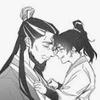
Wei Ying lets out something between a laughter and a sob as he feels the stranger’s presence closer; so close, terribly close, but still not touching him: he is grateful and disappointed. Wei Ying falls, resting his head against the stranger’s chest, smelling the smell of the fire instead of the ash that clung to himself. Wei Ying grasps, holds on, clutches at the other man’s clothes, pack and dab, splitting and gathering, falling apart and laughing.
Wei Ying also beats on another man’s chest: without purpose, without meaning, without intention to hit the important points — he is not stopped, he is allowed until he is exhausted, until his arms ache.
Wei Ying hides her eyes in the crease of her husband’s shoulder and neck, begging exhaustedly and impersonally:
“Hold me”.
And warm hands hold him; and it’s comforting; and he floats in the void.
(He feels a hundred hands tearing him apart.
He doesn’t mind it.)
***
Wen Xu was absolutely certain that Wei Wuxian had bewitched his father. At first he thought it was some kind of move by his father, one of many that he would later tell Wen Xu to figure out, as if he were still fifteen and just learning the basics of strategy. Then he decides that it might be his father’s not entirely healthy fascination. That wasn’t to say that such a thing had happened before (in fact, his father had only had a second child out of love for him, so as not to burden the burden of having an heir, knowing that Wen Xu couldn’t bring himself to feel arousal; the warmth of love — yes; something from book descriptions of intimacy between people, no matter the gender — no; and such a waste of potential that that child turned out to be today’s Wen Chao), it just seemed even stranger, for his father had said that he had inherited his traits, including unassuming for a sect head. What is equally strange is the age of his father’s new husband; one so young that it borders on the obscene; barely of marriageable age, and already not just negotiated, but a marriage has been consummated. Wen Xu understands absolutely nothing about this marriage, especially what his father has found in a child who looks incredibly distant from the scene of their ceremony, with empty eyes and muscular movements (Wen Xu might think it’s the face; but this isn’t the first handsome face that’s wanted to get close to his father to at least breathe the same air as him; and this boy could easily be Wen Xu’s own son, what the hell kind of conversations his father could have with him). But also, Wen Xu is not blind. One would also have to be deaf, stupid, and thousands of li away from their lands not to notice the obvious favoritism (Wen Xu refuses to call it a crush, though he can perfectly see how fuqin resembled shushu when he looked at his wife) of Wen Ruohan towards his new spouse. Many thought it was a perverse passing interest, or a long-term plan, or a devious tactic for future realizations — as the clan elders vehemently lamented — but then the reality they all found themselves in one unremarkable morning presented itself. The truth was that apparently from now on, the most powerful person in the entire Wen Sect was Wei Wuxian, aka Yiling Laozu. (They still don’t know the reason for the name; its origin and significance; but the way his father pronounces it, as if it were a title worthy of an emperor — corrupts him.) And don’t even get Wen Xu to remember the headache his father gave him ten days ago by canceling all their plans. (His father waves his hand aside as if it were nothing: disband the army, — as if there were not those years of preparation, as if there were no plans, calculations and steps already taken; then his father turns and asks him with the most serious tone: “What would be appropriate for Yiling Laozu to present: a set of paintings or a dizi first?” Wen Xu hears the silence so distinctly that his eardrums burn. “…what?” “Yiling Laozu has set a limit of one gift per day”, and his father sighs as if it’s really a hard decision, “which is extremely disappointing”.) That being said, Wen Xu couldn’t even form an opinion on Wei Wuxian (his father had almost challenged him to a mortal combat when he called this boy tianfang[wife who “filled the vacant seat”]), whom his father was hiding like a bloody heavenly treasure. Wen Xu doesn’t want to know, much less see what his father can do with a boy all day long, but he would love to behold what fascinated his father. Of course, Wen Xu recalls shushu’s words (be careful what you wish for, A-Yu, misfortune doesn’t need an extra invitation to show up, — shushu reasoned, though he wasn’t much older than his own nephew, as they secretly made their way out to stroll the night streets; with dancers moving smoothly in the lantern lights and hypnotizing music blaring; with sweet berry scones in his hands, glistening with oil and strangely similar in color to the round rings in his shushu’s ears) when he appeared in the wrong place. Wen Xu doesn’t know what could have brought him here, other than chance and whisper like voice from his uncle leading him. It’s still the same lights he’s seen a thousand times standing on any of the palace balconies; it’s still the same spring smell as summer approaches in thick thunderstorms and sharp winds; it’s the same image he’s never seen but could imagine in his nightmares (his shenmu who walked around in white for the last year like a grieving ghost before meeting the ground; his shushu who left his ring earrings on his desk without a word and never returned); is the image of a man who should be a stranger to him, should be nothing to him — but Wen Xu had never been fooled by what such deaths did to his father, to himself. Wen Xu was next to him before he even thought it over. Wen Xu grabs someone else’s hand, catching someone at a moment like this for the first time, and introduces himself to Wei Wuxian.***
It wasn’t a perfect evening for anyone who knew and who will find out.***
Wen Ruohan had never thought that loving someone was easy. His family, the one he knew young and blinded by the naiveté of his childhood, was not one to take an example from. His two older brothers had died before he was born, and by his fifteenth, his two sisters had been given in marriage too soon: one gave birth to a dead child and did not survive on her own; the other poisoned her husband and herself. Wen Bao, not yet given his polite name, knew not the love that would cost him. He was born out of cruelty, where his mother couldn’t look at him, and he bestowed it on others; three more brothers and one sister. He stood at the top alone with commitment, strength, and an emptiness that had no beginning or end — then, just before he had gotten rid of his father as well, he had met Nie Tao. Perhaps the only person who had looked at him and decided that there was something of a human in him; perhaps the only person who had wanted to know him; perhaps the only person who had shown him what it was to live, to experience anything at all. He hated him; gods be witnesses, he’d wanted to kill that man for as long as no war had lasted; but that’s what happens when you feel something. And somewhere in the middle of it all, decades later, he could find longing and gratitude. Strangely enough, this man had explained to him what it was to be devoted to someone; what it meant to do something for another; why he might enjoy it. Then he decides that the man is crazy, but, then, his younger brother, his xiao di, the only one left, is born, and… he decides to give it a try. The heavens would rather collapse than have Wen Ruohan admit it out loud: Nie Tao was right. Love was a process he had to learn, on par with sword techniques and controlling his qi. It’s what he studied, refined and developed. It is what gave him a reason to be who he is. It is what Nie Tao might call happiness, but Wen Ruohan considers it contentment. Of course, after his didi was gone, his brother’s children either fear or despise him, and his own youngest child wasn’t worthy of even one additional mention, he got bored. This eventually led him to plans that didn’t make sense. He just wanted something that would give him challenge. And, oh, after everything, after death, after a second life, he got the greatest challenge of all. He had found Yiling Laozu. Wei Wuxian, Wei Ying, the chief disciple of the Jiang Sect, young, zany and warm — easy to love. To love Yiling Laozu — is different. To love a man whose hands are in the blood of multitudes, enemy and kin; whose fame is many leagues ahead of him, with no end or edge; whose songs command the dead; whose eyes are unlike human eyes, bright red like grave flowers; whose smiles and laughter can haunt weaker men in their nightmares — that is another thing altogether. To love one who does not reckon with the world, before whom the dead of the earth lay a path of their bones, who is feared for the very fact of his immoral existence — is unjust. Because Yiling Laozu was still a part of the very Wei Wuxian that everyone who knew him loved. The most fierce, the most uncouth, the strongest, and the most honest of all sides of that man. But he’s still the one people loved. And then turned away. And it makes Wen Ruohan so angry that thinks he might be inflamed. Because Yiling Laozu deserves to be honored. Because Wei Wuxian, Wei Ying — is not a separate ephemeral being that killed the monster that came out of the Burial Mounds and stole his face. Unfortunately, he doesn’t think Yiling Laozu himself realizes this, pretending to be something he isn’t quite, and wanting to escape so far away that he thinks no one will follow him. Death — is not something Wen Ruohan would accept, but if he had to, he would follow; he seems to realize for the first time what his didi was thinking. (At least that’s what he tells his confused son, thanking him for his work with a pat on the shoulder. He does, after all, have his greatest job of all. To help someone who doesn’t want it.)***
Days go by when the fall has not taken him. He is drunk, he knows he is letting the alcohol master him; his meridians burn; it hurts — he deserves it. He drinks, drinks and drinks, until Wen-zongzhu stops him, taking the wine away; and Wei Ying laughs — grim and unfunny, detached and uneven. He looks at the man he should hate; maybe some part of him still hates the man who burned down his house like it was worthless. And Wei Ying hates him. Hates this worry, hates this concern, hates that he can’t find the lie in it. So he laughs when Wen-zongzhu, Wen Ruohan — his executioner, his enemy, his husband — extends his hand to help him up. Wei Ying looks at him, studies him, remembers: that shoulder width like Wen Ning’s, that thin smile like Wen Qing’s, that slit of eyes like A-Yua… don’t think. Oh, that hurts. He hates that person, even though he has so much in him from the people he loved. (Loved, still; even if they never knew him). Wei Ying laughs as glass cracks and bones bend, as he pulls the man down: he has a golden core and strength along with it; this body has known no hunger, no incurable injury, no agony in every breath. He also knows that he is allowed to catch a cultivator as fabulously powerful as Wen-zongzhu, sit him down on the cushions, jump on top, on someone else’s lap — Wei Ying continues to laugh. It’s absurd. All of it. His whole life.
